Tampilkan postingan dengan label building. Tampilkan semua postingan

Selasa, 22 Maret 2016

Plywood Boat Plans Australia | Todays motor home on the water

,

Plywood Boat Plans Australia


I like to sail on boats that I can see and feel the wind. By seeing the wind I can see the ripples on the water, by feeling the winds I can tell when running down wind at night how far the wind has veered by the feel of it against my ears and neck. I also sail to see and enjoy the pure energy of how a vessel moves along by the force of the wind. When entering a Harbour under sail all my senses are on alert to avoid shoals ,other boats and to see a possible wind shift.
So my sailboats are very clean of gear on deck and around the cockpit. At sea I can rig in a second a nice sun awning from the boom gallows to the aft railing supports that were made for this. When its blowing hard I take this awning down and now have a clear view. When going to weather in rough going the wind vane steers the boat and I can just sit in the doghouse and watch the world go by. 
Coming into port in nasty weather I done foul weather gear and just deal with it. At anchor we have a very nice awning setup.

Todays group of sailors think in a different way. These people were raised on tv , computers , video games and commuting by car long distances while talking on the phone and listening to talk show hosts that are bitching about something. These people are used to being in enclosed areas on the way to work, at work and when they get back home. One day they decide to become a sailor - cruiser and start on the computer looking up what they need to live on a boat that will make them feel at home.
This trend has brought us the Island Packet crowd, the huge Room-Ma-Ran catamaran crowd and all the other group of sailors that want to stay under cover till the last instant when one of them has to go forward and lower the anchor. Otherwise they want to stay in what is the equivalent of a sailing motor home. In the typical cockpit of one of these vessels you will have a steering wheel that is over shadowed by a huge GPS system flanked by the VHF and loud hailer . To see around this getup one must stand up on tip toes to see over. Now the compass is in there somewhere but this crowd has the GPS full map system so who needs to look at that , all i need is my waypoint book .
Sailing under a fully enclosed Florida Room like you see on the intra costal where they enclose half the property and pool area under a huge screen cage . Side flaps down , the little window to maybe look up at the set of the mainsail but who does that and the sun might find me so its closed.
What the whole sailing experience comes down to is seeing the goose neck of the main boon and maybe the genoa tack at the bow.
Sensory deprivation at its best. But hey the sun cant find you under  all this crap.
At night with the GPS TV show going on all night vision is gone . But the good this is theyre in the safety compound of the FLORIDA ROOM.

Id rather experience the sea that I sail on. 


Todays floating CARAVAN-MOTORHOME at rest . They have missed the channel completely . The wind is in the east coming from their stern . They have set the anchor to leeward in the channel they should have been in. Three more of their tribe are consoling and trying to figure out what to do. 
In passing by in our dinghy going home I suggested to put a kedge out to windward and put a strain on it so when the tide floats them they will be heading into the wind and not drifting into the channel and onto the leeward rocks. They got off fine.

But iam sure they missed the channel because they were not looking at it but at their GPS TV show
Enclosed in the saftey of the FLORIDA  ROOM.


Do you find information about Plywood Boat Plans Australia are you looking for? If not, below may help you find more information about the Plywood Boat Plans Australia. Thank you for visiting, have a great day.
Read more

Kamis, 17 Maret 2016

Boat Plans African Queen | Star 45 Keel fins building options Star45

,

Boat Plans African Queen


{Rule7.2}
Keel fins may be solid or hollow and constructed of reinforced plastic, plastic laminates, fiberglass, wood or metal. (Note: Strength and integrity of the keel fins must be maintained whether built solid or hollow.) Keel fin shape is not specified but must follow the general shapes outlined on the reference drawing. However, keels will not be less than 6 inches nor more than 8 inches long (Fore and Aft) at the keel/hull junction, nor less than 4 inches nor more than 6 inches long (Fore and Aft) at the keel/ballast bulb junction.

--
The Mainwaring Keel shape is a fine choice!
--

John Fisher suggests:

The quickest and easiest way to make them if you have access to a metal band saw is to draw the keel in CAD, then print it out. Glue that to a sheet of 3/32 aluminum with 3m77 and cut it to shape.

You could also do the same thing with sheets of plywood and layer it to achive a airfoil shape. Each layer should be smaller than the last and then sand to blend the layers. Could also make a good cad project.

Another way is to cut the shape in two pcs of 1/16 ply, then tape the edges together. Insert a couple of threaded rods between the two sheets for attachment. Then fill with epoxy and microballoons. Using this method you should also glass the outside for additional stiffness. There are photos of making a rudder like this on the blog site.

--

Do you find information about Boat Plans African Queen are you looking for? If not, below may help you find more information about the Boat Plans African Queen. Thank you for visiting, have a great day.
Read more

Selasa, 15 Maret 2016

Boat Plans Uk | Sailing Model AMYA Star45 Class building board

,

Boat Plans Uk


"John Fisher" is building Star 45s. He has provided a series of photographs taken as he builds the model from scratch.
These are posted to the blog along with his notes to help builders assemble the Star 45.

In the following posts you will find comments, notes. and his photographs

Photos showing the building board and the first couple of steps for putting the frames together.
Building board is 3" wide 3/4" MDF that is glued/screwed together.

The notched balsa template is glued to the building board using a straight edge. Use a staight edge to make sure it stays straight.


Do you find information about Boat Plans Uk are you looking for? If not, below may help you find more information about the Boat Plans Uk. Thank you for visiting, have a great day.
Read more

Minggu, 13 Maret 2016

Yacht Boat Plans | Sailing Model AMYA Star45 Class building rudder

,

Yacht Boat Plans


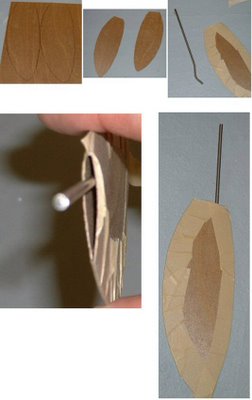
Here are some photos showing one way to build a rudder quickly and easily. The quick overview is cut out the shape in a thin material, tape the sides together, insert the rudder shaft, fill the inside of the rudder with epoxy. This takes about 10 min or so to do. Followed by installation in your boat.

John Fisher

Lay out the rudder shape on a sheet of 1/64 ply. On other class boats John used a single layer of a 6 oz carbon fiber layup, so you could also lay up some fiberglass for use on the star. To do a glass layup, just take a sheet of 6 oz or heavier fiberglass, a sheet of lexan or plexiglass, and some resin. The first step is to spread resin on the plexiglass, then apply the fiberglass and then make sure it is all wetted out. Once cure flex the plexiglass and the layup will pop off.

Shows the two sides cut out of plywood, these could be fiberglass instead. Straight sided shapes like shown and the star plans are easier to make.

Tape the two sides together with masking tape. With curved shapes He taped them together then insert the shaft and resin. If you use straight sides on the rudder you can tape one side and then open it up like a book, apply resin, then close and tape shut. The open book method uses less resin but only works with sq or straight sided shapes.

Note the bend John put in the shaft to prevent it from turning inside the rudder.

Shows the top open to pour in resin. John uses a syringe to pour in resin once the shaft is in place. You can add micro balloons to the resin if concerned about weight.


Installing Rudder in Star 45

rudder brace

rudder tube


tiller

rudder link

John Fisher photographer


Do you find information about Yacht Boat Plans are you looking for? If not, below may help you find more information about the Yacht Boat Plans. Thank you for visiting, have a great day.
Read more

Selasa, 08 Maret 2016

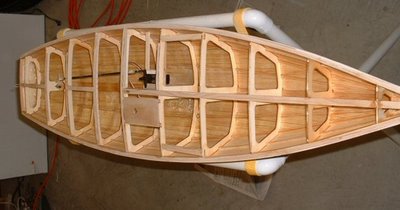
Boat Plans Bateau | Steps toward building a sailing model

,

Boat Plans Bateau


Building Displaying Sailing
Model Boats and Ships

So you want to build a sailing model
Find plans for a sailing model, buy or find on-line.

Join a model boat forum for advice.

Buy or borrow books on boat building.

Decide on type of planking and wood to be used to build the model.

Set aside a work space for building.

Review the bill of materials need to build the model and buy the materials.

Order deck and mast fittings.

Order mast (if you are buying the mast) and order sails (or sail material).

Choose the radio system, buy a sail control unit, Order keel bulb or get advice and discuss issues of building your own.

While the hull is under construction build:

Keel fin and ballast bulb

Rudder assembly

Make or assemble spars ( mast and booms)

Build cradle to hold boat under construction and when finished.

Test Radio System and sail control unit

After hull is planked:

Install keel trunk or make provisions for mounting keel.

Install radio and sail control unit, Then remove while construction continues.

Construct deck and hatches

Install/mount deck fittings

Test access to radio and sail control inside the hull.

Provide a exit guide for radio antenna so it can be attached to mast or stays.

Install power switch for turning off batteries

Test mount keel

Paint hull, rudder and keel

Assemble hull, rudder and keel

Set up mast and boom.

Install radio controls.

Check running rigging.

Attach Sails

dry sail model

--

Sail
Display
Storage


Do you find information about Boat Plans Bateau are you looking for? If not, below may help you find more information about the Boat Plans Bateau. Thank you for visiting, have a great day.
Read more

Rabu, 02 Maret 2016

Boat Designs And Plans | My GLADES SKIFF style concept

,

Boat Designs And Plans


After I left Hells Bay Boatworks the company designed a skiff that they called the Glades skiff. Its a nice long skinny shallow skiff for getting around the Evergldes and shallow narrow spots. Its supposed to be good to pole by one man and use very low horsepower engines. A nice simple long lean skiff. It is not intended for big open waters, long bay trips and steep chop. With two people on board it will balance out well when poling. 

Today lots of people have followed suit and have been coming up with lots of different variations on the Glades skiff. Now the Geenoe company and many bayou builders have been doing their version for a long time but these new skiffs are supposed to be a bit more seaworthy and maybe look a bit more traditional.

Lately I have met a bunch of guys via emails that are obsessed with designing and building the lightest Glades type skiff to be able to go in really unaccessable areas. Even so much as to drag their skiffs over dykes to get into other areas. Several have sent me pictures of beautiful skiffs they are building.
This whole concept got me thinking lately ,so here is my idea - version for a home built super simple and very light weight Glades type skiff. 

 What I have observed from the skiffs I have seen so far on the internet.

- Lots are very narrow with big engines.
- Most all have spray rail issues , as having been retro fitted. Not wide enough. Not long enough to protect the helmsmen.
- All start with very flat runs and some get into a good vee.
- I can find no good pictures of them running in a good chop with the bow trimmed down so as to show how dry they are in running. 
- Most all look wet in a beam sea. ( most all skiffs are).
- All have their spray rails up very high but these skiffs are intended to fish in very shallow and protected waters so why so high so as to not catch the spray ?
- Most all have very simple interiors. No pretense of carrying everything with you like other flats skiffs.

With these thoughts in mind here is my design.

I will start with the sheer and work down. I feel that in a simple skiff like this you are not going to be carrying a lot  of stuff so only need simple watertight lockers. I like a nice sheer so have broken away from convention here and drawn a slight sweeping sheer. The deck I have lowered to sit on top of the upper spray rail. This deck will be very light over conventional decks . The sheer will be a 11/4" PVC tube instead of a rub rail. This will save lots of weight and is a very strong and resilient rub rail.
 ( see my drawings for this detail).
With the deck lower your center of gravity is lower so you and the boat will feel and be more stable when moving about. Also in the bow it will make a great fly line catcher.

The upper spray rail is a detail that I introduced in the Whipray . This idea came from looking at all the old boats like the Challenger skiffs, Fiber Crafts and others that had spray rails but seemed to always be just not right. In the Whipray it has worked well. Today I would make it wider. So too with the Guide and others. Why not . In the HB glades skiff I would make that one way wider and longer. It looks like little T- REX rails up almost under the sheer.

In the Marquesa design I tried to come up with a new look with out having the spray rails go all the way aft. Hal  Chittum in his skiff has come up with a very aggressive spray rail. I like this bold move .I do not like the deep vee part of it for the extra work it involves , the extra weight and where does the water go when it gets in there? Lots of people have been adapting the Marquesa spray rail look with most notably the East Cape company. I like the way their Glide Skiff looks with this adaption. Hals spray rail is getting used too in Spears skiffs. To me this is all good. They work if done right so why not. Now lots of skiff builders have put them on but seem to have lost their nerve about width so have ended up with too skinny a chine. On this skiff it will have a monster wide curved and sharp edged upper chine spray rail that will flow down to the waterline to catch what ever spray is coming up. It will be very wide all the way aft past the helmsman to protect him.

Now here is where I have gone off the beaten track is in the placement of the engine.

All these skiffs have heavy engines on their sterns. Now add the guide on top of it. Up goes the bow .
But hopefully you are not alone. Hey its nice to have somebody else pole too. 
I have put the engine forward in a small well to move the guide and motor weight to a more central location. This means he will have a better chance of staying drier by being forward of the spray that always seems to come aft. 
The engine will be on a simple pivot mount so it can be lifted out and forward to sit level in the center of the skiff. Nice balance. When running you will use the usual Handel bar rig with your sport sitting on the cooler in front. This is a nice place to be if running in a beam sea . Very dry here. If going into a big head sea trimmed down and the motion is too much then just sit aft next to the guide.
With the engine in this position the skiff will spin on a dime, will run very level if needed which means it will plane at very slow speeds with little tab needed because of where the weight is. Good for small horse power. The engine well hole will have an ever so slight wedge in the hull to not catch the running water going past and  some other details that will keep it dry.

Ok, now you are on the tower polling . I have drawn in a rounded stern that is crowned in its curve so as to be very quiet with the seas aft. Also very easy to pole around. The bottom of the hull will be straight but this will flow into the curved stern .The tower shown will be on a sliding track so you can move forward up to the engines transom area to get your weight centered when alone . Or move it aft with a sport aboard . Will be a very quiet hull poling backwards.
 
The bottom details are thus, the centerline keel of the skiff has a slight rocker in it fore and aft. This I do for better poling a long lean skiff. Also to let the bow trim up when needed. The single trim tab is to over come this when running when needed. Trim side to side by human weight and save a trim tabs cost and weight. 
I like my little chine-let detail if done right as I think it gives you a drier ride. What it does is when the water leaves the first bottom chine edge is start to curl upwards but the next slightly down turned chine edge now redirects this spray. Look at skiffs running with this chine area filled in . The spray is blowing out away from the skiff. Now look at the old HB skiffs and see the difference. They have filled this area in now on some of these skiffs which makes the boats a bit faster I guess and in a turn more stable.If you fill it in it will be a stiffer turn and this to me is not so much fun.  I also have drawn in my usual reverse spray chine that I introduced in the Whipray design. Today I would be very aggressive in its use and placement in lots of the skiff designs I see. It really works well so why not use it all the way to the bow area ? I will. 

 This boat can be built in foam core strips like Corecell bead and cove or just in cedar strips. It consists of just the hull, a flat cored deck glassed with one layer of 7 oz. cloth on each side. Two hatches with my new two fastening only hinge system that will never leak. No hinges. And two bulkheads. 
Should weigh way less than 300 lbs all up or less with more exotic cloth and resin. My 12 3" dinghy weighs 130 lbs in just regular resin. This boat will be great with a 15 hp two stroke Yahmaha that you can still buy over here in the Bahamas for $2,300.00. It weighs 89 lbs. your speed with two people will be 18 mph or so. I get 22 mph in my 12 skiff . 
 
Now if you want to take the engine off and go in a no motor zone I have a Chinese Yuhlo design to skull with to get across deep water . Very simple.

Or ???

If these drawings are not clear on this blog go to my facebook site , they always seem to come out clearer there.


Having ridden in a 12 3" dinghy for the past 26 years every day running with babies, wife and all our stuff in it trying to stay dry  I have been looking at , cussing at spray for a long time. Hence the big sray rails . Small boats just cannot go fast enough to get past the spray on a beam sea. What you sea here is an improved 12 skiff with a stern added to get the length for moderate planning speeds, less gas, very dry and comfortable and to pole well.


Central weight for modest planning speeds , dryness and comfort. Aft tower slides on a track from above the engine to the stern for conventional use.


Spray rail and sheer detail. This system I have been using on the sheer for 29 years on my skiffs. Very resilient as we are always banging up against docks and stuff. The PVC strip on top makes a very good non scruff rub bumper. Also very light. Not copyrighted go for it.


New hatch hinge system that I have been using on Hogfish Maximus for  12 years. This would eliminate at least 10 fastenings per hatch to drill out, fit and hope to not leak. Also dead simple to get the hatch to fit level. With rubber washers will never leak. Cannot be retro fitted but can be used on all new builds. I have not copyrighted it so go ahead and use it.


My design office in its usual state .


New Design iam working on for Tom Gorden and his Islamorada Boat Works . Hes commissioned me to come up with a new skiff to compete in the HPX, HB Professional, East Cape, Chittum skiff market.
Iam almost done so will post the process in a week or so.


Our family truckster, Minimus


Do you find information about Boat Designs And Plans are you looking for? If not, below may help you find more information about the Boat Designs And Plans. Thank you for visiting, have a great day.
Read more

Selasa, 01 Maret 2016

Boat Plans Bateau | Building Hogfish and Hogfish Maximus

,

Boat Plans Bateau


Lawanda my ex wife and I were offed free use of a small building , the use of an old house and a very old Volvo station wagon . The stipulation was we had only six months time to use as the property was to be sold. The building shed was built around Sonna tube concrete collums with roll up doors on three sides. The buildings roof was 60 long and the enclosed part was 33 long with a 14 foot door opening. I decided to make the Hogfish 3110" long and 9 wide. I could just get around the boat with the doors shut. This was 28 years ago. The marine grade fir plywood then was still wonderfull. All the dimensional lumber was clear fir. I was able to buy a bunch from Lew Mcgregor and Russel Brown as they were starting to build a big Catamaran for a client but the deal fell through. All these photos were taken by friends as I was busy building this boat. I keep daily work records of what I get done and my hours. These I look back on for reference and to see that iam getting older and not getting as much done today as I once did. The Hogfish took just under 1,300 hours from start to sailing away . Lawanda had a full time job . She helped me with the painting. She did all the cooking and stuff ,so i could just put in the 10-12 hours a day to get her done in time. 


Stringers in place with sheer clamps and Chines


The skin is 3 sheets of 1/2 " plywood on the bottom and just two on the sides.


Thats our benefactor Ron McCartney looking through the glass bottom opening. Glass bottoms are great fun when sailing in clear water but you have to be in 10 or deeper as when in shallow water your speed is too quick . Our kids would lay down looking at the bottom for hours when going over the banks.


Overkill stem detail


Iam actually upside down here showing how the companionway will look and the cabin floor size.


Centerboard pin is just above the waterline


Starting to roll the boat over.


The problem with the shop was this small doorway in the back. We could only roll her so far and then would have to slide her over a bit. 


On her side and being slide over. This took a long day to do with Ron as my helper.


When the Hogfish was almost finished my father came to visit. He designed buildings for a living and had taught me a lot. Dad walks in the side bay door looks at the boat and out the front door of the shop where we were planning on sliding her out of. Dad says" your boat is too wide to fit out the front door". I grab a tape measure and measure the side door which was12 wide , the back door was 12 wide the front door looked exactly the same. But it was just under 9 ! Ron had built the building and was flabbergasted ! We had to slide her out the back door and around the building over sugar sand to get near hard ground for a crane to be able to lift. A bit more work. Since then I very carefully measure all exits .
Launch day. Hogfish was a very good boat for us. Now she has had many owners redesigning and adding on stuff so ugly that I will not post a photo for how buggered up she looks . Sorry Hogfish but we just outgrew you.

Hogfish Maximus ....same thing but lots bigger.


The inside first skin sheet of plywood is marine grade MDO ply which is very smooth and paints well. The rest is AB marine grade ply. 


The deck is two layers1/2" ply with a1/2" Corecell core on top for insulation.


I use a simple pallet jack to lift up a bit to slide this frame under and then use these pipes to roll out. Very easy .


Big box boat.


At the time I was building the HFM I was running Hells Bay Boatworks with a dozen employees building about 10 custom skiffs a month. To save time I hired 2 cranes to roll her over with.  
Cost $450.00 and took 2 hours .


The hull at this stage weighed10,000 lbs.


Only a shape a mother could love.

Getting ready to put on a trailer and launch. The color scheme is made up of two primer colors . I new I would be hauling out later to finish paint so to be silly I did this .
Building the HFM while I was building all the other skiffs took a huge chunk out of my life and my familys. I would start my day at 6:00 . The boat shop crew would start at 7:30 . Our working ours were to 3:30. By around 2:00 I would try and start working on the HFM. This I would do till10:30 or later. Come home eat dinner and sleep. Start over. Sell boats , train crew, order supplies, fire crew, work on HFM. Took me 10 months of this routine to get a bare but livable HFM launched and in the water. We moved aboard within days. Had her sailing a few months later. Total hours 1,980. Cost $34,800.00
I was 40 then and it would take me twice as long today.

My sharpie boat designs are built using the " Northe System"
      NO
      OTHER
      ROUTE
     THOUGHT
     HEAVY 
     ENOUGH


Do you find information about Boat Plans Bateau are you looking for? If not, below may help you find more information about the Boat Plans Bateau. Thank you for visiting, have a great day.
Read more

Jumat, 19 Februari 2016

Boden Boat Plans Australia | Building skiffs in the Bahamas

,

Boden Boat Plans Australia


27 years ago my marriage to Lawanda ended. Quite simply we grew apart. She wanted a more stable life and I just wanted to keep on looking to see what was around the next point of land.
We had that year finished building the Hogfish and had sailed to Spanish Wells in the Bahamas to start a boat building company there to build out board powered skiffs to be used in the lobster and scale fish industrys there. Spanish Wells is known for their great fishermen, and farmers but had never had a boatbuilding economy. Boat building in the Bahamas was done in the Abacos mostly in Cherrokee , Man O War Cay, and sporadic one off boats in the out islands by individuals. In Man O War cay the Alburys had been building dinghys, skiffs, power skiffs and large custom yachts for several hundred years. All in wood. In the last century the Alburys in several different familys had moved into fiberglass 
Boat production . Willard Albury had the most sought after hull in fiberglass at this time. His main market was in Spanish Wells for the Crawfish industry. Tourism in rental boats had not been started.
The Alburys had been building for many years one off carvel planked skiffs . The wood crooks and knees they needed had become scarce. Also good planking pine was hard to find. They made the move to fiberglass.
I had been coming to Spainish wells since 1977 . Lawanda and I had bought a piece of land there in 78 . I loved the people and fell in with them easily as I loved spear fishing and building boats. They always had boats to repair and fish to kill. We settled into a routine of sailing over from the Florida keys in June and I would work on skiffs to get them ready for the August Crawfish season. I was able to go away for several August fishing trips that would last for 3 weeks. In doing this I was able to spend lots of sea time in all the Abaco skiffs, from wood hulls to the 3 models that were built in fiberglass.
 The Alburys are excellent builders. Their fiberglass boats will last forever. Just beautiful.
My buddys in Spanish Wells were always after me to come over and build skiffs for them. The Alburys were a year behind in orders. Every year boats were lost and the wood boats were dying off.
The year before Lawanda and I had lost our Morgan 34 at sea .( another story) . We had built the Hogfish so this seemed like the perfect job to get us back on our feet and in the Bahamas full time.
Work permits were not a problem. 
When Willard Albury went from wood to glass he picked what at the time was a big hull at 183" long with a nice vee. These boats had when built in wood a spray rail that ran the length of the boat that was 11/2 " wide the whole length. In going to glass he tapered it as it neared the bow. These skiffs also had very tight radiuses on all edges. The boats have a very distinctive look. They are built in solid glass to massive dimensions.
What the locals asked me to do was come up with a bigger longer skiff. More vee as Willards skiff at certain angles would " spank" . The boats slid in a turn, make a mold for a center console , do each boat as a custom order to fit the client ,make it look the same and could I soften the edges a bit.  
Having been in many skiffs at that point fishing and traveling around in up to8 seas for days on end I had a good vision.
The new boat was194" long , deep vee with lifting strakes, freeboard the same as the smaller skiffs, but the spray rail was wider and ran all the way to the bow.
During the start up of this project my marriage ended with Lawanda. She moved to the states to do her thing. I ended up with the Hogfish and all our dept. 
While building the plugs for this skiff I looked up one day to see Rachel looking over the sheer in the skiff hull I was fitting the stringer plug in. 
Long story short it was love at first sight. 26 years later and lots of adventures we are now getting ready for our next cruise. If you do things well in life you get to live many different lives.
After launching hull number one it went off to sea the next day for 23 days. When they came back the word was this was it. The next day we had orders for 29 boats with deposits.
Willard Albury switched to building rental skiffs .
153 skiffs were made from the molds I built. Today half the skiffs in Spanish Wells are these boats and the other half are the modern Panga boats which are better suited to the industry now.
Rachel and I stayed there for 2 years, had our daughter Kalessin and when she was 6 months gave notice and sailed away for ten years. 
We eventually came back and built our home here. I like it here because every one has at one time or another been to sea in my skiff. If you sail into the harbor here just ask anyone for Chris the boat builder. Theyll tell you whats up with my life .


Putty on the plug.


Spraying primer on for final fairing.


Plugg mover around for more space. Waxed.

New shop built. I built all the plugs and molds on a sloping shop space at the water front as they took forever to build the shop. Was a pain to level every thing up.


Mold ready to pull. I like to core my molds. Nobody would belive that it would come loose.


Made my day!

 
My young workers 15&16 years old. Spanish Wells is a white community of Bahamaians that have lived on this island for 350 years. The young boys at the time would finish school at 15 . By 16 or so they would find a fishing boat to go away on. 


Moving into new shop


Laying up hull # 1


# 1 going in 


Production going on. The young Black Bahamians that worked for me were 16 years old when they started. After I left they went on to build 143 more boats with my training over a 14 year period.


Rachel Married me on the beach here. Her only request was that I wear a belt. We were bare foot when married. In cutting the first piece of cake her mom had brought this small wedding cake knife for me to use, I pulled out this cutlass and  did the job the proper way.


Do you find information about Boden Boat Plans Australia are you looking for? If not, below may help you find more information about the Boden Boat Plans Australia. Thank you for visiting, have a great day.
Read more
 

Boat Plans For A Chesapeake Deadrise Copyright © 2016 -- Powered by Blogger