Tampilkan postingan dengan label in. Tampilkan semua postingan

Jumat, 25 Maret 2016

Plywood Boat Plans Australia | RE slots in laser cut frames and stringer from old forum notes 8 31 2010

,

Plywood Boat Plans Australia


Ray wrote: >
need to know what are the vertical > slot in frames 4,5,and 6 for also what size stringer goes into frames right > at the bottom where the bottom of hull meets the side of the boat also there > seems too be a slot for another brace on frames 4,5,and 6 directly under the > vertical slots.
Thanks Ray from Down Under

the vertical slots are for the radio tray if you use it. the extra vertical slots by the king plank are just extra strength for the keel area. Chines are 1/4" X 1/4" or 6.4mm sq.

John On 8/30/10,

Do you find information about Plywood Boat Plans Australia are you looking for? If not, below may help you find more information about the Plywood Boat Plans Australia. Thank you for visiting, have a great day.
Read more

Kamis, 24 Maret 2016

Boat Plans Nz | Cape to Rio Race Starts Tomorrow

,

Boat Plans Nz


It has been a long slog to get here and, strange as it may seem, even now I am not sure where "here" is. We need to be on the start line in Table Bay at 14h00 South African Time (UTC+2) and have been working toward that goal for a year. Now that we are almost there time-wise, we have had all sorts of issues popping up to try to trip us and prevent our participation. Each time that we side-step an issue, another appears in its place.

These are not problems that are directly related to the boat, neither are they related to most of the crew. I cant say what they are but they have been a major distraction in our preparations, detouring our efforts and moving our focus from much needed work into stuff that really should not be on our minds at this stage of preparations. These issues sap energy and drain enthusiasm. It takes effort to maintain optimism, which is normally self-fortifying.

We expect to be on the start line tomorrow and will be deeply disappointed if we should be prevented from going. Only time will tell whether or not we will be there. Watch for the yellow boat if you are able to watch it live, or maybe recorded live (whatever that means).

From here on I will not be posting on this blog live until after the race is over and I return to USA. I will be sending email updates to my wife, Dehlia. She will be posting on the blog but it will probably be without photos. Our Internet connections via satellite phone will be too slow to transfer photo files. If we have something really special to show then we may make an exception.

So please follow us via the tracking link on the race website at http://cape2rio2014.com. This is not a clickable link, so please copy and paste into your browsers address window.

Do you find information about Boat Plans Nz are you looking for? If not, below may help you find more information about the Boat Plans Nz. Thank you for visiting, have a great day.
Read more

Canoe Boat Plans | Black Cat in the Governors Cup Race

,

Canoe Boat Plans


In my last post I wrote about how well the Didi 38 "Black Cat" was faring in the Governors Cup Race to the South Atlantic island of St Helena. I am writing this post based on information that I have read on the official web sites of the race and False Bay Yacht Club.

They were going like a train in showing the way to all of the monohulls. Then they sailed into a hole in the otherwise good tradewind sailing breezes. This was created by a rather odd shape to the South Atlantic high, as an elongated sausage running east/west and in two parallel bands of calm not far apart.

Skipper Dave (Wavy) Immelman was kicking himself for having missed a crucial weather download that may have helped him evade the holes. They sailed slowly through the first calm then the winds started to pick up and they thought they were through, only to be trapped by the second calm.
"Black Cat" rounding the Cape of Good Hope en-route to St Helena.

We watched in dismay as the Vickers 41 "Avanti" sailed a big arc that took her right around the hole in which "Black Cat" languished, at pretty much twice the speed. We despaired for the chances of "Black Cat" even catching "Avanti" before the finish line, let alone getting far enough ahead to beat her on handicap. In the end "Avanti" crossed the finish line about 7 hours 10 minutes ahead of "Black Cat".

I went to bed last night feeling sad that the hard sailing done by Wavy and his crew for so much of the race was thwarted by the fickle winds. I woke this morning to the news that the skipper of "Avanti" declared some time after finishing that they had motored and were dropping down to the cruising division. That leaves "Black Cat" as the likely winner of the racing division, with only "Iechyd Da" with a very distant chance of beating her on handicap.

Congratulations to Wavy and crew. You sailed an honest and honourable race. You didnt deserve the heartache that came from watching your opposition apparently sailing right around you when they had actually motored into a more favourable position.

This brings up two questions that need clarification.
  1. Why did "Avanti" wait until after the finish of the race to declare that they motored? They should have done so immediately that the motor was started. That action disqualified them from the racing division. They didnt declare at the time that they were dropping to the cruising division, so can they be considered to have been racing in that division? None of the other cruisers knew that they were racing against "Avanti" so they couldnt take her into consideration in their tactical decisions. The knowledge may not have had any effect but it should have been open knowledge throughout the fleet within hours of "Avanti" starting her motor.
  2. What is the sense of allowing boats to change their racing division on the water? It may have seemed a good idea at the time that the rules were written but has created a very unfair situation on the water, unfair to those boats that were in the cruising division at the start of the race. The entry list shows 9 boats in the racing division and 4 in cruising. As the race has progressed and the boats ran out of wind, racing boats have chosen to motor and change from racing to cruising division. The leading boat in cruising division changed class after finishing and the 2nd boat changed very late in the race. The whole balance of the event has changed, with the original 9 racers reduced to 3 and the original 4 cruisers swelled to 10 boats. Three of those 4 cruisers have retired and "Tallulah" should get the trophy. Instead she is lying 3rd, with "Avanti" and "Strumpet" having jumped in ahead of her. Maybe the rules of the race have not been broken but I dont agree that this is the right way to do it, in the interests of fairness to all on the water.
OK, I am getting off my soapbox now.Once again, congratulations to Wavy and crew on sticking it out in racing division when it looked like you had been beaten but could have had a clear win in the cruising division by simply starting your motor and changing classes.

See more about the Didi 38 and our other designs on our website at http://dixdesign.com/.


Do you find information about Canoe Boat Plans are you looking for? If not, below may help you find more information about the Canoe Boat Plans. Thank you for visiting, have a great day.
Read more

Rabu, 23 Maret 2016

Boat Plans Canada | Didi 950 Build Started

,

Boat Plans Canada


Michael Vermeersch of Ohio commissioned the Didi 950 design and has now started construction of his boat. He is building from a pre-cut plywood kit that was supplied by Chesapeake Light Craft in Annapolis. The kit arrived as 61 sheets of plywood with all components accurately cut by CNC router and packed on 2 pallets.

Michael reports that he is progressing well with the assembly of the backbone and bulkheads and that everything is fitting together beautifully. A few more bulkheads to go, then he will be ready to start setting up on the building stocks.

Michael with wife Pat & daughter Catherine.
Since adding this design to our stock design list, another three boats have been started. They are in Australia, Greece and Latvia.

The Didi 950 is drawn to the Class 950 Rule and detailed for building by the radius chine plywood construction method. It can be built from plans only or from a kit. Kits are currently available in USA but can be supplied by most of our international kit suppliers as well. Enquire with the supplier in your area and I will send the files to them for pricing. Note that for USA you must order from us, you cannot order it directly from Chesapeake Light Craft.

For our full range of designs, please visit http://dixdesign.com/.

Do you find information about Boat Plans Canada are you looking for? If not, below may help you find more information about the Boat Plans Canada. Thank you for visiting, have a great day.
Read more

Selasa, 22 Maret 2016

Plywood Boat Plans Australia | Cape Henry 21 Launched in Croatia

,

Plywood Boat Plans Australia


Dean Ivancic lives in Porec, Croatia. He bought plans from us a few years ago for the Cape Henry 21. He has been working steadily on his boat and reported to me today that he launched her in April. He has sent me some rather nice photos of her under sail. She is still incomplete down below but has all that is needed to sail.

She is named "Scintilla", Italian for "spark", also the meaning of "Iskra", the Croatian name of Deans youngest daughter.

We wish Dean and his family lots of fun and adventures in their Cape Henry 21.
"Scintilla" on one of her first outings.
Pretty from any angle.
Dean has done a nice job of building "Scintilla".
The Cape Henry 21 is surprisingly quick and has delightful manners. These boats prove that a boat doesnt have to be ugly to be fast.

For more on this design and others in our range, go to http://dixdesign.com/.


Do you find information about Plywood Boat Plans Australia are you looking for? If not, below may help you find more information about the Plywood Boat Plans Australia. Thank you for visiting, have a great day.
Read more

Kayak Boat Plans | Didi 950 Hulls Taking Shape

,

Kayak Boat Plans


The Didi 950 projects of Fred Grimminck in Australia and Mike Vermeersch in USA continue in parallel. Freds build is from plans only and Mikes is from a kit that was cut by CNC router. Both have completed the flat sheet panels of the sides and bottom and are now skinning the radiused parts of their hulls. This is the stage that the hull shape really starts to show.

Some of the photos that I show of these two projects show minor differences, due to building from a pre-cut kit or with the builder cutting all components. Both produce the same boat at the end of the process but they may look a little different at times while being built.

Side and bottom panels all completed, ready for radius to start.
The photo above is of Mikes kit boat, with neat edges at the sheer (where hull and deck will meet). The photo below is of Freds boat with irregular edges at the sheer. This is because the kit panels are supplied with a uniform strip of waste to be trimmed off to the final line after turning the hull over, while the boat built without a kit has the panels inividually cut by the builder and the waste width may vary.
Same stage, Freds boat. Backbone still to be trimmed at forefoot.
The radius is skinned in two layers, made with narrow transverse strips. The first layer lies on the stringers and the doublers of the tangent stringers, fitted between the edges of the side and bottom panels. These edges have rebates pre-cut into them and onto which the second layer will be laid.
First layer of radius being fitted to Mikes boat.
The rebate along the edge of the side panel can be seen in this photo.
Final hull shape starting to become clear.
Construction of the boat in Latvia has now started and the boat in Greece will soon follow. To see more of this design and others in our stock design range, please visit http://dixdesign.com.

Do you find information about Kayak Boat Plans are you looking for? If not, below may help you find more information about the Kayak Boat Plans. Thank you for visiting, have a great day.
Read more

Minggu, 20 Maret 2016

Yacht Boat Plans | Why Would Anyone Build a Boat

,

Yacht Boat Plans


Why would anyone build a boat? What kind of question is that for a boat designer to ask? I ask it because there are so many people who ask it in all seriousness. They ask it because they really cant understand why anybody would build a boat instead of buying one. There are so many boats out there that are available and can be acquired with so much less effort, new boats, good used boats, boats that have been damaged in weather events, tired boats that can be rejuvenated and almost dead boats that can be resuscitated.

There is no single answer to that question, there are many reasons why people build boats for themselves and each builder no doubt has a bunch of these reasons rolled up inside whatever it is that drives him to build his boat.

A reason that is common to all of the builders is passion. They have a passion to create a boat, to create something that would never have existed were it not for them and their desire to do this. Having been there myself many times, I can attest to the fantastic feelings that flood through when we first put that new boat into the water and then to give it life by hoisting sail or opening the throttle for the first time. If you think about how wonderful you felt when you first used a new boat that you had bought, doing the same in a boat that you have created with your own hands intensifies those feelings in ways that cant be described.
Petr Muzik built his Shearwater 39 then circumnavigated in his 70s.
It is that passion that also drives many of the decisions that are made during the build project. It drives them to do quality work because they want to feel pride in the final product. They want their creation to show well when seen by others, to be seen as a thing of beauty. Those who have never thought to build a boat themselves look at it and say "Wow, did you build that?".

Financial restraints are behind many amateur boatbuilding projects. If you need or want a new (as in not pre-owned) boat that costs double the money that you can afford to put into it, then the only route to get it is to build it yourself. I have never calculated ahead of my boatbuilding projects how much they are going to cost. Each time I have just dived right in and started, then kept going to the end. That was when I found out what the total cost was and was able to compare with what it would have cost me to buy an equivalent new pop-out production boat. Each time the cost of my fully-equipped boat was around 45% of the cost of a base-package for a production boat of similar size and concept.

Those who dont get it say "It cost you a lot more, you havent priced in your labour hours, which must be priced at your professional rate of pay". No, we dont price our labour into the project and no, we should not price it at the rate that we receive in our paying jobs, whatever they may be. The project serves as a hobby, as recreation that helps us to recover from a tough week working for someone else. It helps to keep us motivated and able to take on the world. The alternative of working very extended hours at our paying jobs to generate the funds to pay someone else to build our boat brings with it a risk of getting burned out in the process.
Andrew Morkel built his Argie 15. Now he and his family are learning to sail in it.
Many people who build big boats for long distance cruising want to build it themselves to give them confidence in the strength of the boat. They know that they will be sailing their boat on very remote waters, far from rescue services and possibly with their beloved family aboard. The safety of all depends on the quality of the build and they dont want to leave that to people whom they dont know. They have vested interest in doing everything in the best manner possible, so they want to do it themselves. In the process they garner the side benefit of knowing intimately how the boat works, where all of the important parts are, how to get to every seacock or filter in a hurry when dictated by some emergency that may develop onboard. They know exactly how to repair everything onboard because they installed it in the first place. They are likely to lay out all aspects in a very sensible and logical manner because they will have to maintain it themselves. At sea in a storm is not the best time to be trying to track down plumbing or electrical faults in systems that are overly obscure because the person who installed them before the hull liners or lockers were installed didnt consider the problems of working on them in the completed boat.

Others build their own boats because they want something different,  a boat that will stand out from the crowd on marinas, at sea and in distant anchorages. They add personal styling features to fit their own characters and they choose joinery detailing such as is not available from production boatbuilders.
Sergey Federov built his Hout Bay 33 to a very high standard.
Some people choose to build a boat purely for the hobby benefit. They enjoy the build more than using the boat, so the project will be drawn out interminably. They produce exceptional quality in the process but will probably sell the boat when completed or soon after.

It has been said many times that the happiest days of a boatowners life are when he buys and when he sells the boat. The exception to that cliche is the boatowner who has built his boat himself. There is so much of the builder wrapped up in that boat, in the form of blood, sweat and tears, to say nothing of chunks of skin and body hair, that he and the boat have an affinity and  intimacy that is unknown to those who buy their boats. I have felt very sad when selling each of the boats that I have built, far from the happiest days of my life.

It has also been said many times that boatbuilding is a disease and when you have had it, you will experience periodic relapses. I have to agree with this one, I have had numerous relapses. I cant say that I have suffered relapses, as would apply to most diseases, I have enjoyed those relapses too much to convince my wife that I have suffered in any way. And this is the way that most amateur boatbuilders feel. Visit any of the many boat shows that cater for amateur boatbuilders and you will see for yourself how much they love what they do and just how much passion they build into their projects.

To see our range of designs, for amateur or professional boatbuilding, please go to http://dixdesign.com.

Do you find information about Yacht Boat Plans are you looking for? If not, below may help you find more information about the Yacht Boat Plans. Thank you for visiting, have a great day.
Read more

Sabtu, 19 Maret 2016

Wood Boat Plans And Kits | Fire in the hole

,

Wood Boat Plans And Kits


The minute I opened the door leading from the  back deck in to the salon, the faint smell of oil got my attention. After having spent the last 30 years earning my living owning and operating heavy equipment, one has to put trusts in what our various senses are telling us. Odors such as the faint smell of coolant as its vaporized while running down a hot engine block, the smell fuel makes as it comes in to contact with hot exhaust, the smell of brakes getting hot and making its way into a cab after motoring down a long grade. Most times, the odors of  machinery tells the story long before the gauge registers a problem...stop and investigate. On this particular day, I was coming in to the boat after topping of the power steering reservoir the  previous night.  Not having tightend one of the lines that passed through a bulkhead fitting allowed 3.5 gallons of oil to drain in to the bilge over night, and the odor I noticed as I entered the boat alerted me to a problem. 

Having the exhaust finally fitted and landed took a few days as I sourced parts. The biggest slow down on the exhaust was deciding on what material to use as a liner within the exhaust stack, then getting that material to the boat. Self adhesive, high performance heat shield was what I chose to use, and for the most part Im happy with the product. I can for sure say that it sticks like crazy and theres no second  chance regarding alignment.  Besides deflecting radiant heat, this product will help with harmonic noise bouncing around the exhaust stack. I only lined the exhaust side of the stack, but I have plans to also line the intake side of the stack.


On my last post I had mentioned making some righteous exhaust hanger brackets. I dont think well be calling theses righteous, but they do the job of securing the horizontal exhaust pipe simply and robustly. I didnt know if the hanger would transfer dangerous heat to the ceiling, so I bored a couple of one inch holes in the hangers to  help cool them. Little things sometimes make a big difference. 

With the exhaust hung and secure, the next item was to commission the steering system, and give myself something to write about for my first paragraph regarding the oil leak. The steering system is powered by a gear that runs off the engine cam shaft, and is identical to what one would find on a heavy duty truck or road tractor. Since all the steering plumbing had been installed two years ago, getting it ready to go only involved installing the rudder, filling the reservoir with oil, and installing the steering wheel. The rudder bolts are going to get another look from me as the nuts are not the correct type. I had planned on using nylock nuts, but my bolts are too short for that, and if I go the nylock route, Ill have to order new bolts. Gregg, at Washington Marine suggested keeping the same bolts but tack welding the nuts and bolts to the flange. Tack welding might be the way to go as I dont think over kill is a bad thing when making sure ones rudder is secure.  

With the steering system full, crank case oil full, coolant full, and gear box oil full, it was time to fire the engine.  Moving two valves on the fuel delivery lines, and throwing a toggle switch, placed my back yard boat builder designed fuel lift pump system in service, and fuel was soon flowing in to the filters. With fuel flowing out the primary and secondary filter bleed valve, I quickly cracked the fuel line at the injector pump and fuel was soon flowing out that fitting. After closing the line at the injection pump, the little lift pump started to load up as it was beginning to dead head from hitting the injection pump. The sound of the lift pump dead heading told me the fuel system was full, as the little lift pump did not have enough ass to push fuel through the injection pump. Past experience has taught me to go ahead and crack the six injectors on the head and begin cranking the engine. With the engine cranking, I closed two injectors, and she began to fire. Closing the next injector caused the engine to run without the starter, and with the closing of the last three, she was sounding sweet. Having the external lift pump to help bleed the system turned bleeding the fuel system job into a quick, and easy, two minute job. 


After watching the engine run for a few minutes, and checking for leaks, I moved up to the helm to see if the steering system was operating. Engine powered steering is awesome. As soon as I began to move the wheel, I could instantly tell it was  working. I cranked the wheel over three and a half times, and I felt the rudder slam in to the external rudder stops. Another three and a half turns the other way, and  the rudder slam into the other stop. Now I have to find some rubber  or a pad of sorts for the corner of the rudder, as the force of the rudder hitting the stop is taking off paint.  Ill go ahead and say this again for all that did not hear... 3.5 turns of the wheel hard over to hard over.... awesome.
All the insulating and sound abatement Ive been doing during the build seems to have paid off. With the engine running at a healthy 1700 rpm, one can easily carry on and hear a soft conversation in the wheel house. Id like to get a decibel meter to see just how loud the engine is. With the engine at a  high idle, the loudest part about the engine is the rattle of the exhaust rain cap flapping.
The punch out list is growing by the day, and a lot of the list can be done when I start doing sea trial. I ordered bottom paint from the boat yard today, and if the weather cuts us some slack, I should have the bottom painted by this time next week. I also ordered control cables from the boat yard, so if push came to shove, I could drop her in the water within the next two weeks.
Cheers


Do you find information about Wood Boat Plans And Kits are you looking for? If not, below may help you find more information about the Wood Boat Plans And Kits. Thank you for visiting, have a great day.
Read more

Jumat, 18 Maret 2016

Dinghy Boat Plans | Multihulls in the islands

,

Dinghy Boat Plans


We are anchored in Prince Rupert Bay in Dominca today. The sail down from the Saints was in 30-35 knot close hauled conditions. The HFM made the crossing of 19 miles in 3 hours with three reefs in the mainsail and the 1# jib. When tacking into the bay we had to sail into an excelleration wind zone with gusts up to 40. With the jib furled in half we still put the sheer down to the water for the first time but had no problem tacking in and anchoring under sail. We have renamed these the exzilleration zones. There are 93 sailboats anchored here today. Five years ago at the same time there were only 10 yachts. Times are changing. The town boasts new roofs, docks, a half built huge hotel , and is remarkably clean. The place has gone through a clean up act. 
Having asked the boat boys how business is with all the yatchs about they say it is down because not so many charter boats that spend the money, just cruisers that only spend a bit in each island. They understand that our boats are our homes . But they do their best to help out and to see what $ can be earned from this crowd. 
Yesterday , Tim , Gayle, Rachel , I and our daughter Lillian climbed and hiked up one of the mountain peaks here taking 5 hours for this hike. It is mostly strait up on slippery leaves, rocks and mud. Going up the trails is hard but going down is worse as its so steep and slippery.
Today is recovery day so I will post some boat pictures in various categories .
I will be showing cruising multis mostly. A simple nice cat.
A fast looking tri in Guadaloupe sailed by a young couple.
This tri comes apart for shipping.
An oldie foiler. This tri has got to have some tales to tell.
This I belive is a Rodger Hatfield design . Built in plywood. Very simple and very strong.
Going to rot in Guadaloupe as this tri is outdated already.
A nice old Newick wooden tri in the Saints.
Simple plywood catamran . Truth is it takes as much time to build this boat as the HFMS as you have to do every thing perfect. The HFM in plywood could build 3 of these easyily. No lead though.
31 tri in Antigua. Looks fast but not so sexy.


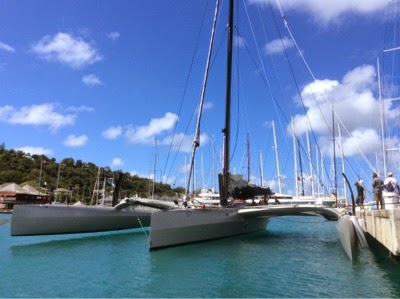
A Nigel Irens tri getting ready for the Caribbean 600. I have had the pleasure of drinking rum and getting drunk  with this great designer talking shallow draft boat ideas and designs a few years back after a days racing during the Antigua Classic regatta . I was sailing on "Gaucho" a 65 double ended Mario Campos design from Argintina as tactian. We won third place in our class. 
This Dutch tri has anchored in front of our place last spring . They hung out for a couple of days waiting for a good weather window to sail to Bermuda in. They like light winds of 10-15 knots of wind as this tri would sail at 4-5 knots faster than wind speed so in 12 knts they would be doing close to 18 knts. When the wind got up so would the seas and so would the spray, motion and noise. After 18 knts they would then have to slow down to be comfortable. All boats are a compromise.
The Dutch speak such perfect English it makes me feel like I should go back and study my own language again. The woman that was sailing on this tri had built it herself years before with a husband and then sold it. With a new partner she found it again and bought it back. A work of art and a sailing machine.
Here is Lew Mcgregger on his Russell Brown Proa " Cimba" cruising with us on Hogfish 23 years ago. 
What a great concept. So much fun to watch them sail into a bay heading into the fartest Cornner with no room to move, suddenly stop , swing the mainsail around and sail back and out on a new tack and new bow.
This is Rodger Hatfields 31 tri built and designed by him in wood,ply and nomex. Here we are sailing out of Salt Run in St. Croix to go over to St. Thomas to do some warranty work on the first wave piercer power tri. This boat was a dream to sail as it was so fast you could just breeze by any sailboat. We closed reached over the 42 miles at an average of 18 knots an hour. This shot was taken 24 years ago.
This is my own Dick Newick Val  31 trimaran that I salvaged from a remote island in the Bahamas. It was sunk up a very hard to reach creek. I will be bringing this boat back to life when we return from this cruise. Its taken apart now and up high and dry for the Hurricane season.  It should be very fast as I will use all my knowledge to keep her light and strong with todays modern materials. So far I have removed whats not needed and she has risen by 6" . I feel this will be the fastest Val to date when Iam done. Iam looking forward to this project. This boat will be my fantasy speedster if I can handle the pressure. Ive told Rachel she will have to share a tooth brush and only wear bikini bottoms with Pareos only. Must stay light and fast.
This tri and my other sloop project are both 31 long have the same size masts and sail area. The tri weighs 1,900 lbs  designed vs the sloop at 9,800 lbs. The tri has one bunk. The sloop We can live in comfortably.
When we eventually sell the HFMS these will be our Bahama sailboats. I hope to live long enough to enjoy these boats.


Do you find information about Dinghy Boat Plans are you looking for? If not, below may help you find more information about the Dinghy Boat Plans. Thank you for visiting, have a great day.
Read more
 

Boat Plans For A Chesapeake Deadrise Copyright © 2016 -- Powered by Blogger